Educating for a Just and Sustainable World 

Facebook Twitter  Vimeo Spotify


Blog

“It’s the Monster”: Revisiting Steinbeck’s The Grapes of Wrath

It’s a novel about migrant workers escaping environmental catastrophe, being subjected to racist abuse and robbed of their dignity and basic rights by extreme poverty.  It has the ingredients of a contemporary narrative of forced migration driven by climate change but The Grapes of Wrath was written during the Great Depression and the mass displacement of farming families by drought, floods and the dust bowl in south-west America.  The dust bowl migration was the largest in America’s history with the number of migrants reaching 2.5 million by 1940.  John Steinbeck immersed himself in the migrant experience and had already published two books, In Dubious Battle (1936) and Of Mice and Men (1937), about the labouring class in California.  But The Grapes of Wrath became his towering achievement with the physical toll of writing 260,000 words in a year nearly finishing him as a writer. During one of his long trips along migration routes he witnessed deplorable conditions in migrant camps in the valley of Visalia, California, where he tried to assist starving workers marooned by floods, knee deep in mud and lacking basic sanitary facilities.  He invested the seething anger induced by these experiences into his writing and said ‘I’ve done my damndest to rip a reader’s nerves to rags’.  In his introduction to the book, academic Robert De Mott describes its mission to expose:

“the entrenched power, wealth, authority and consequent tyranny of California’s industrialized agricultural system (symbolized by Associated Farmers, Inc.) which produced flagrant violations of the migrant’s civil and human rights and ensured their continuing peonage, their loss of dignity through threats, reprisals and violence…”.

The market as ‘monster’
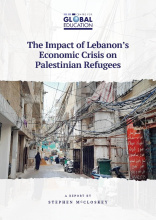
The Impact of Lebanon’s Economic Crisis on Palestinian Refugees

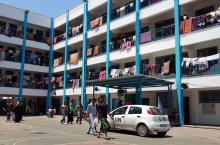
The Centre for Global Education has published a new report which assesses the impact of Lebanon’s four-year economic crisis on the socio-economic status of Palestinians.  The report is based on field visits carried out in May, September and November 2022 to nine Palestinian refugee camps in Lebanon, which included consultations with UN staff and visits to camp installations, notably schools and health clinics.  The report focuses specifically on the health, education and situational poverty of Palestinians in Lebanon since the precipitous collapse of Lebanon’s economy in 2019 which has seen a ninety percent depreciation of the country’s currency.  The World Bank ranks the financial crisis in Lebanon among the worst economic crises globally since the mid-nineteenth century and the economic contraction experienced by the country as one ‘usually associated with conflicts or wars’.

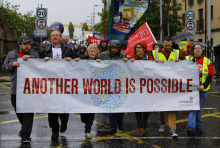
Poverty is a Political Choice: Another World is Possible

Stephen McCloskey

Five days before Christmas, members of the Royal College of Nursing (RCN) were on strike for the first time in one hundred years.  They were forced into industrial action to secure a living wage commensurate with inflation and decent working conditions just two years after they were applauded by a grateful public from their doorsteps during the pandemic.  A highly trained and invaluable workforce, nurses were among the frontline public workers who put their lives on the line to protect the rest of us from COVID-19.  Now, they are among the in-work poor that include retail staff, classroom assistants and factory workers found by the Trussell Trust to make recourse to their foodbanks for emergency food parcels.  With one-in-five or 14.5 million people living in poverty in the UK and struggling to meet essential needs, particularly food and energy bills, inequality for many has become a permanent condition.

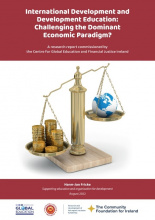
Why are INGOs Avoiding the Question of Neoliberalism?

This blog reflects on new research that investigated the extent to which development NGOs and development educators are engaging with the dominant economic paradigm, neoliberalism, as the 'root cause' of global poverty and inequality.

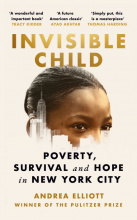
A Powerful Account of Racism and Poverty in America Exposes Stark Inequalities in the World’s Wealthiest Economy

This CGE blog reflects on a compelling new book about racism, homelessness and inequality in America based on eight years in the life of an African American child, Dasani, growing up in a gentrified New York, the US's most unequal city.  

15-years of Israeli Blockade of Gaza has created a Humanitarian Crisis

The COVID-19 pandemic and a funding crisis in the UN agency for Palestinian refugees has exacerbated the humanitarian emergency in Gaza caused by Israel’s 15-year blockade.

The Inequality Variant: How the Pandemic has Accelerated Global Poverty

This blog reflects on the 2022 Oxfam report Inequality Kills which finds that global poverty has accelerated during the pandemic while the wealth of the ten richest men has doubled.  It calls for tax and redistributive measures that put an end to extreme wealth and ensure sustainable resourcing of the social economy (education, health, transport etc) and an ecological recovery.

The Foodbank is the Canary in the Coalmine of Neoliberalism

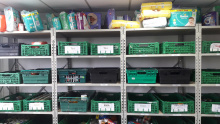
A callous welfare system, wage poverty, austerity and, now, the COVID-19 pandemic have resulted in a 33 per cent increase in Trussell Trust foodbank use between 2019-20 and 2020-21.  The Trussell Trust’s network of 1,471 foodbanks in England, Scotland, Wales and the north of Ireland distributed 2.4 million emergency food parcels to ‘people in crisis’ from April 2020 to March 2021, 980,000 of whom were children.  The extraordinary scaling up of foodbank use has seen the number of emergency food parcels increase from 61,000 in 2010-11 to more than two million a decade later. 

Policy and Practice: A Development Education Review Celebrates its Fifteenth Anniversary with a Special Collection

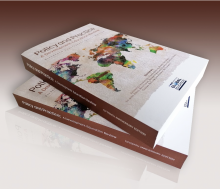
The Centre for Global Education has released a special commemorative hard copy edition of its bi-annual journal, Policy and Practice: A Development Education Review, to celebrate its fifteenth anniversary.  Policy and Practice was first funded by Irish Aid in 20025 to increase understanding of the underlying causes of poverty and inequality, and set out how these can be communicated in educational settings and institutions.  Policy and Practice has since become one of development education’s most articulate vehicles for debating inequalities both within and between the global North and South, encouraging active engagement on the part of learners to address these injustices. 

Open Veins of Latin America: A Re-appraisal 50 Years On

This blog celebrates the fiftieth anniversary of the publication of the classic study of the European - and later United States' (US) - colonisation of Latin America titled Open Veins of Latin America: Five Centuries of the Pillage of a Continent (1997). Published in 1971 by the Uruguayan journalist and author Eduardo Galeano, Open Veins gives an unsparing account of the five hundred years of 'pillage' that followed Columbus's first voyage to the Americas in 1492 which included indentured slavery, extractivism, colonialism and indigenous genocide. The article reflects on what Galeano's text tells us about the importance of history to the contemporary discourse on development.

Pages