

Trump’s oil embargo of Cuba is really designed to unravel six decades of a socialised model of development premised on meeting social need rather than profit and greed.
Stephen McCloskey
On 29 January, Donald Trump published an Executive Order in which he described Cuba as “an unusual and extraordinary threat” to the United States and threatened tariffs on any “foreign country that directly or indirectly sells or otherwise provides any oil to Cuba”. This has already resulted in the collapse of the national electricity grid three times in March which has prevented hospitals from maintaining emergency and intensive care services. Power outages have also impacted water sources, food security and education delivery in a country that created new benchmarks in socialised healthcare and education provision in the global South.
Cuba produces just 40 percent of its oil supply and since the abduction of President Nicolás Maduro and his wife Celia Flores in January, oil imports from Venezuela, its main supplier, have stopped. Cuba had already been subjected to a US blockade since 1962 which the Cuban government estimates has cost its economy $171 billion or $20 million a day. These are huge sums for a small island economy wrestling with the rising cost of basic goods and severe restrictions imposed by the US on business, remittances and travel to the island. The Trump administration has not hidden the ultimate aim of its slow strangulation of the Cuban economy which is regime change and a return to Cuba’s pre-revolutionary status as an appendage to the US ruled by puppet administrations at Washington’s behest.
Cuba’s model of development
Trump’s threat to “take” Cuba and do “anything I want with it” speaks to an imperial arrogance without concern to the welfare or will of the Cuban people. The US oil blockade represents Cuba’s gravest crisis since the “Special Period in Time of Peace”, an extended period of austerity in the early 1990s precipitated by an 80 percent drop in trade turnover following the collapse of the former Soviet Union. Cuba survived the Special Period through the resilience and sacrifices of its people and the introduction of innovative and sustainable programmes such as organic farming and the use of biomass as an energy source. As the economist Helen Yaffe argues:
“decisions made in a period of crisis and isolation from the late 1980s shaped Cuba into the twenty-first century in the realms of development strategy, medical science, energy, ecology and the environment, and in culture and education”.
A regular misjudgement made by Cuba’s western antagonists, particularly the US, was to bracket the island with the Soviet satellites that started to collapse at the end of the Cold War in 1989. Cuba’s revolution had stronger roots built upon genuine popular participation that characterised the social programmes introduced by the revolutionary government from the early 1960s onward. In 1961, Cuba launched a literacy campaign involving educational brigades totaling 268,420 members that enabled 707,212 adults to learn to read and reduced the illiteracy rate to 3.9 per cent of the total population. This initiated one of the social platforms of the revolution; free education for all citizens at all levels with 10,626 schools currently servicing 11 million people. Women account for 60 percent of the 500,000 people employed in education and occupy leadership roles in 14 of Cuba’s 22 universities. Cuba has also developed a groundbreaking adult and youth literacy programme called Yo, sí puedo (‘Yes, I Can’) that has been rolled out in thirty countries and enabled 10.6 million people to read, with the majority of learners from the global South.
Healthcare
Cuba’s healthcare, like its education programmes, is free to all citizens and boasts the world’s highest number of doctors per capita at 95.42 per 10,000 people. It has a mean life expectancy of 78.4 years, normally associated with countries in the global North, from a GDP per capita of just $13,302. By comparison, the US has a slightly higher life expectancy of 82.1 years with a GDP per capita of $80,706. An interesting point of comparison is that Cuba spends 11.8 percent of GDP on socialised healthcare compared to 16.6 percent in the US and yet the US operates a private health system based on profit. In 2023, 25.3 million Americans (9.5 percent) were uninsured, a figure that looks set to rise dramatically following the passing into law of Donald Trump’s One Big Beautiful Bill Act which could cut health insurance coverage for nearly 12 million Americans.
Cuba has also excelled in medical research as well as services. Its biomedical research team advanced vaccine candidates during the Covid-19 pandemic that enabled Cuba to vaccinate its population and share vaccines with partners in the global South. The island’s internationalist approach to healthcare has seen 400,000 Cuban medical professionals work in 164 countries over six decades providing health services without charge in the world’s poorest countries. This health solidarity is also reflected in the work of the Henry Reeve Brigade, an international team of medical specialists in disasters and epidemics comprising 1,586 medical professionals, including nurses, doctors and medical technicians dispatched in response to emergency situations wherever they arise. Their medical missions have included the 2014-16 Ebola outbreak in West Africa when 250 medics risked their lives while fighting the virus in Sierra Leone, Guinea and Liberia. It also dispatched 593 medical workers to 14 countries during the pandemic, including Lombardy, one of the worst hit regions in Italy.
Cuba’s international health solidarity also extends to training doctors in its Latin American School of Medicine (Escuela Latinoamericana de Medicina (ELAM)), which celebrated its 25th anniversary in November 2024, having trained 31,180 physicians for service in 120 countries. The mission of ELAM is to train doctors from the poorest regions and communities of the global South without charge with the proviso that they serve those same communities in their practice.
In a vindictive act designed to sever health ties between Cuba and the countries in which its medics have been serving, the Trump administration has threatened visa restrictions on the leaders of countries that host Cuban medical teams. This was based on the false allegation that the Cuban medical programmes used “forced labour” that amounted to “human trafficking”; again, a policy designed to isolate Cuba cloaked by a disingenuous interest in the welfare of the Cuban people. These are the same people being collectively (and illegally) punished by US sanctions. Also, suffering are the beneficiaries of Cuba’s medical solidarity with the governments of Jamaica, Honduras, Guatemala, Paraguay, the Bahamas, St Vincent and the Grenadines, and Guyana formally ending their Cuban medical missions in response to US coercion.
International solidarity
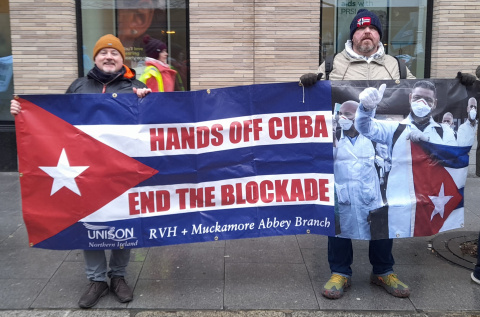
Last month’s Nuestra América aid convoy to Cuba which brought 20 tons of critical supplies for hospitals, schools and families in need was a great example of the solidarity that Cuba enjoys across the world . A total of 650 delegates from 33 countries and 120 organisations brought solar panels, food, medical supplies and powdered milk to the island. They also brought a clear message to the Trump administration: the Cuban political system is not a matter of negotiation but a determination of the Cuban people. At the end of March, a Russian oil tanker broke the US oil embargo carrying an estimated 730,000 barrels of crude oil. A Russian foreign ministry spokesperson, Maria Zakharova, said “Cuba is our closest friend and partner in the Caribbean, and we don’t have the right to abandon it”. This is a sign that Cuba’s international allies are not willing to step aside and allow the US to slowly strangle the Cuban economy into submission. It was followed by remarks from Mexico’s president, Claudia Sheinbaum, that “her country has every right to send fuel to Cuba, whether for humanitarian or commercial reasons”. These developments harbour hope that Cuba’s allies in the global South, particularly Latin America, will support the island in its greatest need. Cuba has offered solidarity to much of the world for more than sixty years and now needs that solidarity to be reciprocated.
Stephen McCloskey is Director of the Centre for Global Education in Belfast.